

The U.S. Constitution, Reconstituted
Fables and cartoons and serial killers…what does any of this have to do with the zine I made recently exploring the theme of my relationship to the Constitution of the United States of America?

This will not be a brief post. But I invite you to board my Train of Thought and ride a while with me.

Preamble
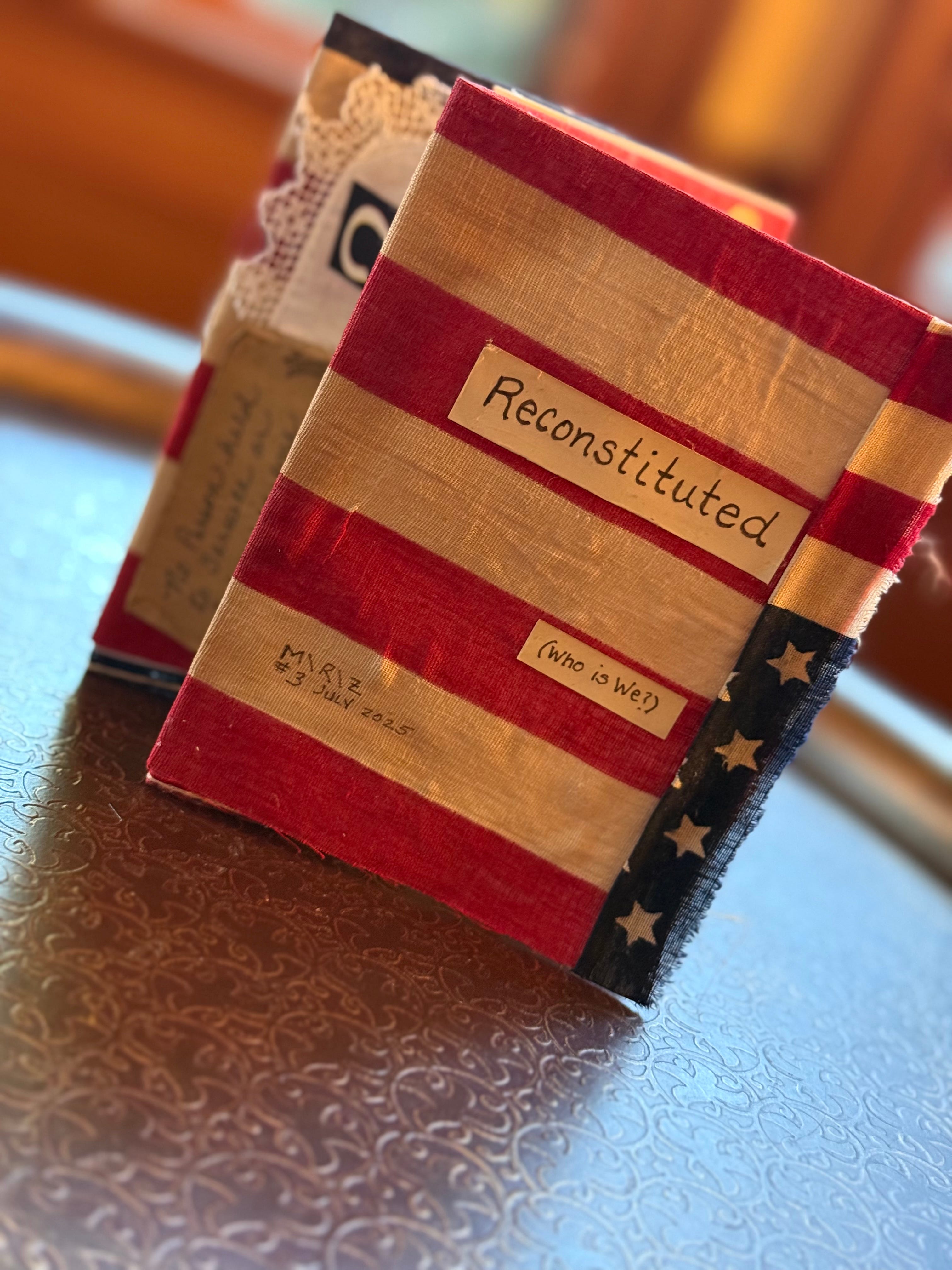
I, an African American woman, am a citizen of the United States of America. In order to explore my feelings about how the “more perfect Union” laid out in the U.S. Constitution could purposefully exclude me in the Founding Fathers’ vision of justice, tranquility, common defense, general welfare—and especially Blessings of Liberty—I created a zine.
This was my third “official” zine. I previously created two zines and thought I had explored the format enough. But last month I was doing a lot of thinking about the concept of betrayal as it pertains to how I often receive the words of the U.S. Constitution, especially around this time of year when we are meant to celebrate our nation’s independence. I decided the brief format of a zine was what I needed to capture some of my feelings in a very visceral way.
I love the outcome of my third zine-making effort. As usually happens when I reflect on my process behind a creative project, my mind went to some interesting places.
Lucy
Lucy Van Pelt is the first stop on my mind trip about my zine, “Reconstituted.”
As a child reading the Peanuts comic strip and watching the Peanuts televised specials, I don’t think I gave much thought to the relationship between Lucy and Charlie Brown. There’s a recurring bit where she encourages Charlie to kick a football that she is holding. Without fail, at the last second Lucy snatches the ball away and Charlie kicks air right before falling to the ground on his back screaming “AAARGH!”
As an adult, I experienced what many parents of children do when revisiting a beloved cultural artifact from their youth with their own kids: I overanalyzed this recurring bit with my adult eyes, seeing/interpreting things that I didn’t when I was a child.
Lucy was kind of a…yes, a bully. Charlie Brown trusted her every time and every time she…yes, betrayed him.
Betrayal. A deliberate violation of someone’s trust.
My adult-self re-watching this exchange recognized that betrayal was going on: Lucy (repeatedly) betrayed Charlie. But why does Charlie Brown keep trusting her, despite all evidence to the contrary? Why does she continue to snatch the ball away, even when the action may cause her own team to lose the game?
In this clip, I get a possible answer to the first question of why Charlie believed, at least in this instance. This time Lucy presented him with a signed document in which she promised not to remove the ball. Charlie’s trust was not in Lucy; his trust was in the document and the guarantees that he understood went along with that document. No, scratch that: Charlie’s trust was not directly in Lucy, but in his belief that she regarded the guarantees laid out in the document as he did.
The United States Constitution is kind of like Lucy’s document. I’ve never felt any sort of special reverence for the Constitution besides the belief that as a citizen of this country I should be well versed in it. But I don’t necessarily “trust” it as any kind of contract between my nation and me.
I am not and will not be Charlie Brown.
Lucy created the document she held in one hand as she held the football in the other. And Lucy created the rules by which the document could be valid or not. (“It was never notarized.”) Lucy possessed the power to snatch the football away and would have found any reason to do so, with or without the document she created.
I have mostly considered myself enlightened by my realization that this same kind of attitude can be applied to the U.S. Constitution. It was created by men with power over the creation, content, and rules for the circumstances under which the rules would or would not be applied.
I’ve realized for most of my life that the “we” in the U.S. Constitution preamble never was intended to apply to me.
So no one is gonna catch me having any faith in this piece of parchment. Ain’t nobody gonna find me on my back, crying and screaming when my government snatches the football away as it has time and time again.
I can only be betrayed if I ever had faith in the first place. Right?
Leopards and Scorpions
The next stop for my Train of Thought is in the Internet.
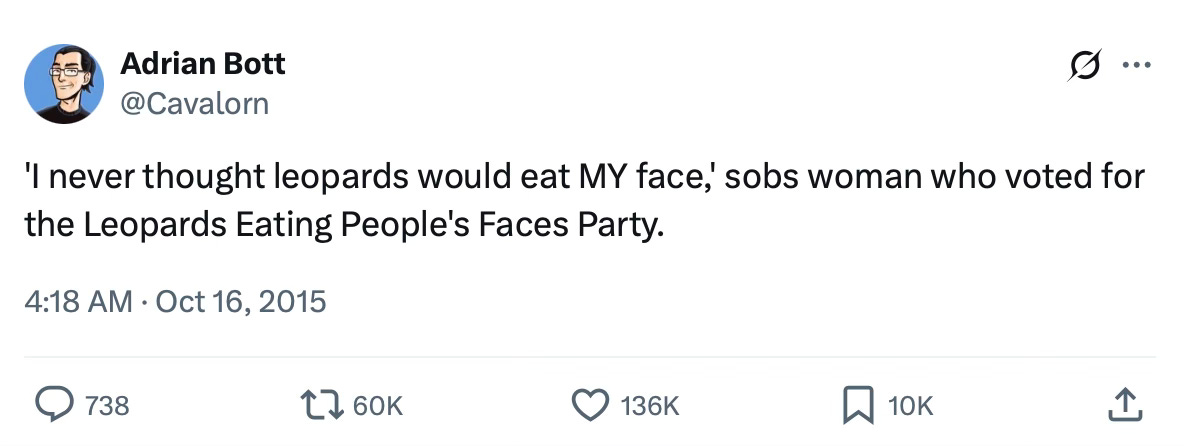
There’s a meme that has been around for a decade that I’ve seen referenced a lot lately. The context is usually a comment section of an article about supporters of President Trump. These supporters express surprise, anger, disappointment, and/or a sense of betrayal about a policy that the President is promoting that is detrimental to them. Folks in the comment sections seem downright delighted that these folks are realizing their betrayal and their own errors in belief and faith.
I generally don’t express this sentiment myself. But not because I feel particularly empathetic towards the supporters.
I recognize that the leopards would likely come eat my face while I’m having a laugh, even though I didn’t vote for the LEPF Party. Also, a part of me realizes that people who’ve had their faces eaten by leopards will not necessarily then come running to support the We Promise Not to Eat Your Face Like the Leopards Party. Instead, they may become disengaged from the political party process altogether. Or they may continue to support LEPF despite the betrayal. Or they may blame others (even me) for the state of their face, maybe latching onto an even more extreme philosophy to make sense of it.
But another part of me recognizes an uncomfortable truth. Whatever party I do support is just as likely to sacrifice my face/body/soul—my entire being—on the battleground of compromise as they are to actually serve my interests.
But that’s not betrayal, right? Because I know not to put my faith in parties of any stripes or spots.
A hop, skip and a jump from my thinking about the face-eating leopards is me remembering the fable of the scorpion and the crocodile. You may have heard it, or one of the many variations:
A scorpion asks a crocodile to ferry it across a river. Crocodile initially says no, saying it knows Scorpion will get on its back and then sting it. Scorpion says, “Why would I do that? If I stung you, we’d both drown since I cannot swim.” Crocodile sees the logic in this and lets Scorpion climb aboard. But halfway across the river, Crocodile feels the sharp sting of Scorpion. Before perishing, Crocodile asks, “But why?” To which Scorpion replies, before perishing too: “I’m a scorpion. Stinging you is in my nature.”
I do believe that inequality is part of the very nature of the United States of America. And here I am not just talking about the inequality with regard to Black folk. Most people who are today U.S. citizens were not meant to be covered in the we of We the People in the constitution.
Yet, many folks seem to have a lot more faith in the constitution than I do. They witness events of the day and sound almost like Charlie Brown on his back, wailing about this or that action of the current administration being a “constitutional crisis”—as if the constitution has not always been both born from and creator of crisis…as if it was not crafted in both crisis and contradiction.
But none of this is anything to do with me. I don’t have any expectations that Scorpion won’t kiss me with its sting if I allow it on my back. If I choose to give it a ride, I won’t be surprised by the likely outcome.
I cannot be betrayed if I know this going into the river.
Right?
Lecter
In the earlier section, I never answered the question of why Lucy would snatch the ball away from Charlie Brown. Is this just in her nature, like the leopards or Scorpion? I know Lucy is just a fictional character. As another fictional character, Jessica Rabbit, might say, Lucy’s not a bully, she was just drawn that way. So maybe that question of “why” in this case is unanswerable.
Regardless, I actually like Lucy. I like how no-nonsense she can be. I like her sarcasm. I like when she shows her softer side in her feelings for Schroeder.
I like Lucy. I love Hannibal Lecter.
(Stay with me. This is the next stop of my Mind Train…)
What—well, besides the whole killing people and eating them—is there not to like about Dr. Hannibal Lecter? Over all of the incarnations of the character in books, movies, and TV, he is, in my opinion, an appealing man.
He is portrayed as suave and intelligent, well-read and well-mannered. He is impeccably dressed, even, somehow, in a prison jumpsuit. He is something of a philosopher and an engaging conversationalist. He is an artist and a musician. He is an amazing cook. (Again, despite what he frequently serves at his table.) Professionally, he is a good psychiatrist. (For patients he does not kill, at least.)
In the case of the Bryan Fuller-world Hannibal, the implication is that he is even a great lover, sexing one woman so thoroughly that she doesn’t find it odd that she slept right through him sneaking from the bed to murder someone.
If you’re not ill-mannered, if you do not annoy him or run afoul of his sense of propriety and good taste, and if he finds you interesting and engaging, he can be a wonderful colleague and friend.
Before his crimes were revealed, most people only saw this attractive exterior of Dr. Lecter. But in one of my favorite scenes of the 2013-2015 Netflix series, his colleague, Dr. Bedelia Du Maurier, lets him know she knows this is all part of a facade.
“This always goes better if I’m perfectly honest with you,” Bedelia begins. Hannibal agrees that there is no point in dishonesty, but Bedelia is clear that only she is being honest in their interactions.
Hannibal: I’m honest.
Bedelia: Not perfectly.
Hannibal: As honest as anyone.
Bedelia: Not really… I have conversations with a version of you… Naturally, I respect its meticulous construction. But you are wearing a very well-tailored person suit.
You’ve been along with me on this journey so far so you know where this strange thought-train is going. In my relationship with my country, I’m the smart one who is being honest even in the face of dishonesty on the part of my country.
I can see that the United Stated of America wears a fairly well-crafted Freedom Suit.
Later in the clip above (please, please, please treat yourself to viewing the whole thing) Bedelia acknowledges that Hannibal’s life behind the person suit, behind his veil, must be very lonely for him. She gently informs him that she does not consider the two of them friends. And as the clip ends, she is about to pour the two of them some wine.
I acknowledge how much inequality must harm my country, how life behind the veil of the Freedom Suit can make the country lonely and incomplete. I proudly call myself a citizen of this country, but not its “patriot.” I can break bread with family and friends and toast the country on July 4—I can even face the flag and sing oh say can you see while simultaneously I know that the flag is a mask.
It’s not betrayal. I can manage the contradictions. Hannibal will not be eating me.
In the season following the clip above, Bedelia visits Hannibal in his gorgeous home to end their patient-psychiatrist relationship. In explanation, she says “I’ve had to draw a conclusion based on what I glimpsed through the stitching of the person suit that you wear. And the conclusion that I’ve drawn is that you. Are. Dangerous.”
(Again, I beg you to watch for yourself to get the full effect.)
No longer is she wanting to share a glass of wine with this man. She just wants done with him. Importantly, she recognizes her own complicity in Hannibal’s actions and her interactions with him despite knowing there was something shady about him.
You’ve been along with me on this journey so far so you know where I’m going with this.
Is it enough for me to understand the U.S. Constitution and the ways it is the document outlining the instructions for the construction of my country’s Freedom Suit? Am I naive for thinking I can survive unscathed here…am I just as bad as the LEPF party supporters or Charlie Brown or Crocodile? Should I leave here—either actually, passport in hand, or metaphorically?
Do I really think my honesty and my knowledge and my proclamations and my achievements and my respectibility can save me from being eaten?
(If you watched the Hannibal series you know how things turn out for Dr. Du Maurier, so maybe that’s my answer.)
We, the People
As I mentioned at the outset of this post, I love how issue #3 of my zine, which I called “Reconstituted,” turned out. I made the master copy out of a small United States flag that I found at my favorite antique mall. The flag is faded and frayed, and stained in places. I consider the state of this flag that makes up the zine a wonderful metaphor for the Freedom Suit that the U.S. is cloaked in.
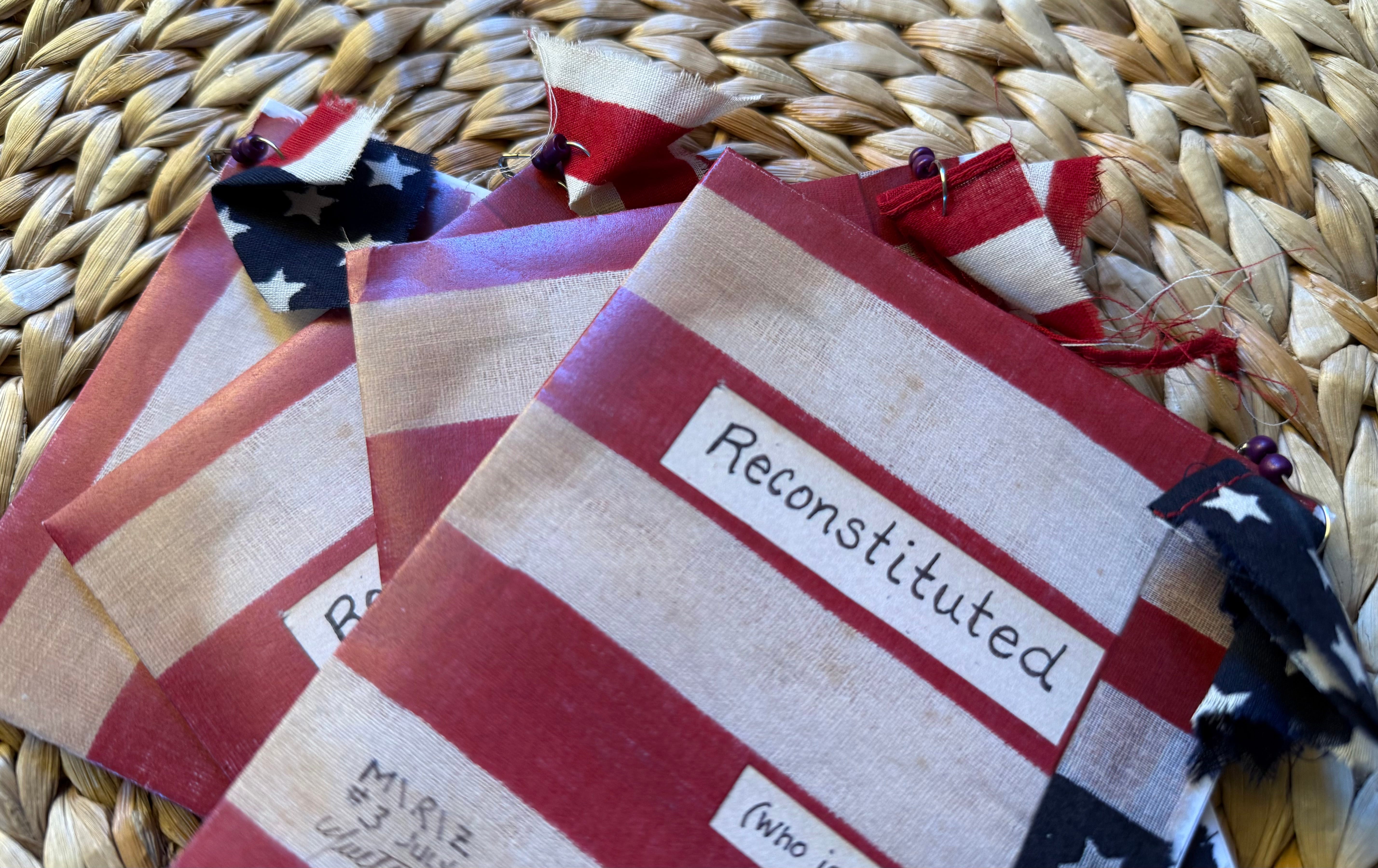
For the distribution copies of the zine, I wasn’t able, of course, to completely replicate the sight, feel, and smell of the cloth flag for people who will receive it. But I did attach a torn bit of another vintage flag onto these paper copies.
I’m not sure how this will be received, like if people will think it is disrespectful to tear up an American flag. But my intent, besides giving folks a sense of an actual flag, is to provide the message that the we of We the People should include all of us. Even if that was not the original intent of the U.S. Constitution. Even if this is not the intent of this current or any other United States government or administration. But more importantly, for many of us it is our responsibility to actively ensure this, instead of expecting this is something that will magically happen.
We all deserve a piece of this flag.
That may be a fairly neat and tidy ending to the journey of my Train of Thought through the landscape of reflections on betrayal. The too long/didn’t read summary of this whole post might read, “I don’t feel betrayed by the Constitution because together we can make it all right.”
If this is my conclusion, then you should know this neatness is part of my own Person Suit.
You should know I vacillate between optimism (believing “more Perfect” is possible even if we don’t expect to reach anything close to actual perfection)…and acceptance (especially since things have definitely worked out better for me in this country than for many others)…and total lack of faith (that sometimes even shows up as rage).
You should know I sometimes feel powerless and other times am confident in my near limitless power. Some days my eyes see glimmers of hope and progress while other days I see only unfinished business with little will to make things better. I feel exhausted when others are calling for all hands on deck; I’m ready to roll up my sleeves to get to work when others are sending out-of-office emails. I feel guilty one day. I don’t give a fuck the next.
And yes, sometimes I totally feel the sting of betrayal. Which means that despite all my best efforts at educating myself and being aware and awake, and everything else, I must still believe. And sometimes that makes me feel absolutely foolish.
Self-Manumission
Now that I have completed my zine, I plan to use this as a touchpoint whenever I feel this mix of emotions. For example, I now have a physical thing to hold in my hand when I think of these people:
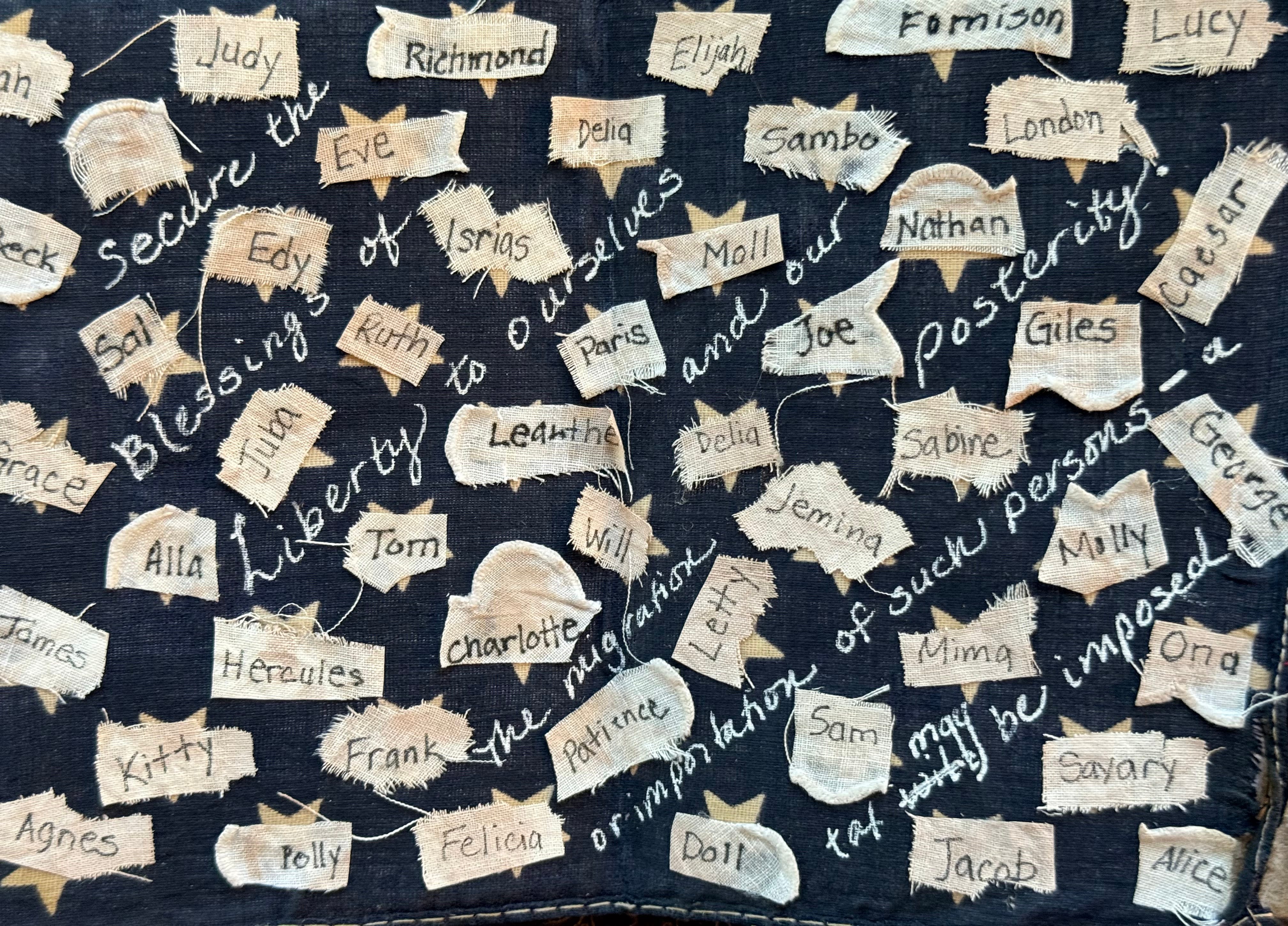
This collage in my zine I called “The Blessings of Liberty.” On the stars of the flag are the names of 49 human beings, which I wrote on scraps of an antique handkerchief, who were owned by George Washington or his wife, Martha. There is one blank scrap to stand in for the names of the couple hundred other enslaved people who the Washingtons owned.
I don’t necessarily have anything against George Washington and didn’t mean anything special by calling him out specifically in the zine. I could have just as easily written the names of enslaved people owned by any number of our other Founding Fathers.
I do find Washington’s particular case fascinating, and we have excellent and extensive records of the enslaved people who toiled under him and his family. At some point I may do a whole post about some of the people glued onto the stars of my zine.
In the meantime, I read and touch their names to remind myself of what I owe to them. The contradictions of a man who rejected the title of King of a fledgling nation but who remained—despite any misgivings he may have had about slavery—their Master was something very immediate and tangible for these human beings. I imagine there was little room for dramatic, pearl-clutching mixed emotions or clever metaphors as Hercules and Ona and Doll and Juba and James and the others found ways to nurture their humanity within a system that did everything possible to deny it.
In this context, any feelings I may have about this messy relationship I’m in with my country are completely bearable. Any stings of betrayal I may feel I cannot allow to be fatal.
I loved following your Thought Train!
As an adjacent Hannibal lover (thanks to you and T) the people suit metaphor is creepy yet apt.
I think about this endless loop every day in law school. The feeling of wanting to “roll up your sleeves” one day and not caring the next, so real! I have hope that this loop will become longer and less needed after the orange man head out. Hopeful that freedom fighters in and out of politics can normalize things again or undue a lot of this harm. Maybe I’ll join in the battle if my career leads me that way or I have the energy when it’s time.
Regardless, I am hopeful that the random day off in July will feel like a real cause for celebration again, the way it felt when we were kids.
Dear Yvette, Thank you for your opportunity to join your Thought Train, even for this brief ride. I loved receiving your zine - unfolding it, looking at how all the pieces fit together, considering it -- and then carefully reading this post. I will be pondering all of it in the days to come. (I am heading to DC this week to visit a friend, and this will be front of mine as my plane dips over all those symbolic monuments.)
I deeply appreciate your honesty, and I do indeed understand how such complex feelings arise. It's important to explore rather than dismiss them; and to allow all the contradictions to co-exist, rather than to rationalize them away. In the past 10 years, my eyes have been more opened than ever to all the contradictions inherent in our government. It's not pretty; even disturbing. And the horrible things that are happening now make it all worse -- perhaps also more clear. I deeply appreciate your insights and the opportunity to ride along. Your work deserves wide readership, and I'd be interested to hear your thinking about that.